Who We Are
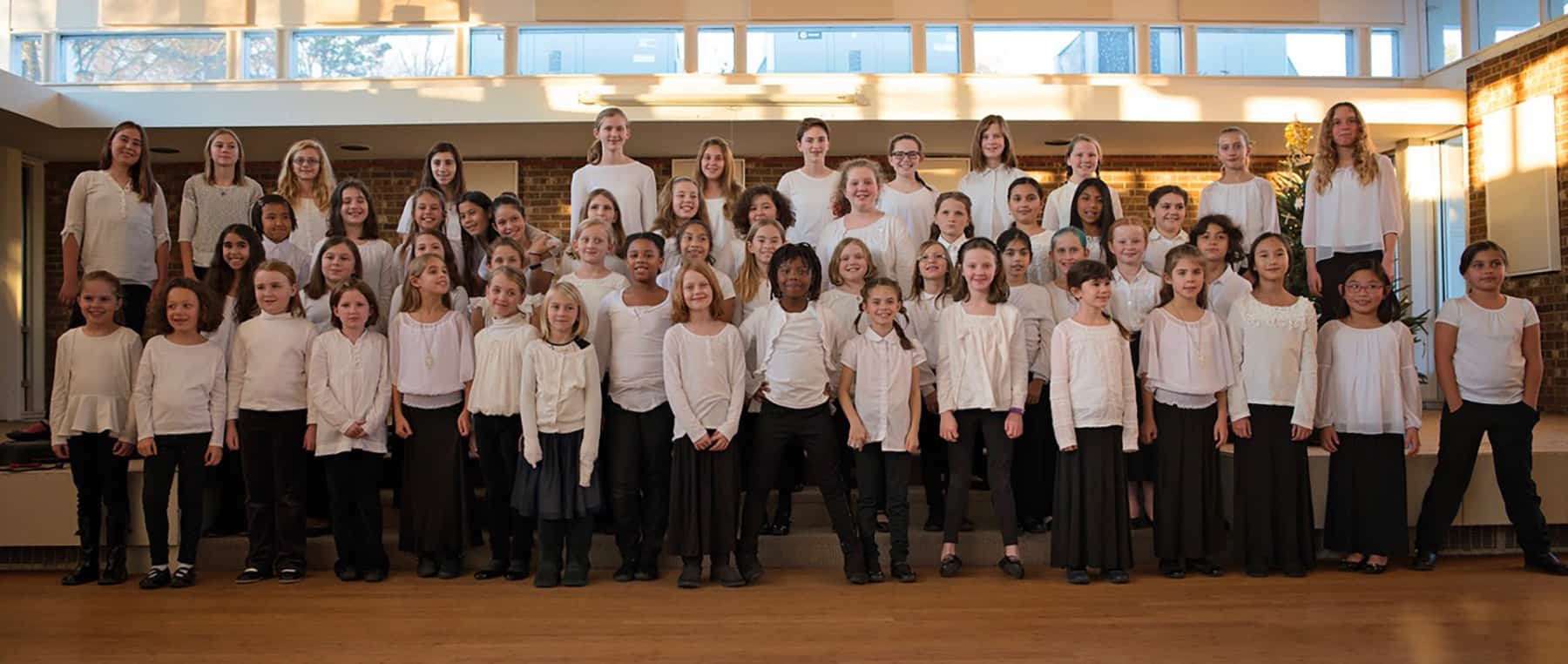
Sisters’ Voices is a choral community of girls, within which each is known and supported while being challenged to grow as a musician and as a person. We are based in Chapel Hill, NC, and serve girls and young women in pre-kindergarten through high school.
Formed in 2008 and led by our founder, Leandra Merea Strope, Sisters’ Voices performs concerts each fall, winter, and spring, appears at local music and arts festivals, and collaborates with local artists and other choral ensembles.
Our work to educate young voices includes both excellent choral training and a Leadership curriculum through which middle and high school singers explore their personal values, build intention around their relationships with their families and friends, and explore issues in the broader world. The friendships that are built during our singing and leadership work are central to the lives of our singers.
Our Mission
Creating a collaborative choral community, educating and celebrating young female voices.
Our Values and Culture
Courage – the willingness to move forward in spite of fear or the perception of personal risk
We ask our singers to take risks every day, to have integrity, and to stand behind their work. As leaders and as an organization, we strive to do the same.
We recognize that sometimes it’s hard to speak up, to share what’s most important to us, to be fully present to ourselves and our communities. We seek and cherish the moments when our singers do just these things. This may look like singing a solo, sharing an important story, sticking up for another person, noticing deep meaning in a song or story, participating in community service – anything that feels like a stretch, that seems to hold both value and risk in some way.
As an organization, we make a commitment to employ women with excellent skills, pay our employees well, and set a high standard for treatment of staff members.
Curiosity – the act of questioning, of holding possibilities open, as an act of hope
We value differences in opinion and culture, and when we encounter conflict we ask lots of questions, seeking to learn from each other.
We value and seek to be led by questions, especially those with no easy answer. When questions have knowable answers, we seek science and experience over what is most popular. We seek kindness over harshness, and we consider telling the truth to be an act of kindness.
Singers show curiosity when they approach a new piece of music, when they get to know each other, when they consider reasons for other people’s behavior, and reasons for their own behavior.
Connection – ties to other people that support us and give us room to grow
Humans seek connection with others. Making music together is one way humans can feel deeply connected to each other; this connection is physical, through vibration, and it is also spiritual, emotional, and social.
We work to know each other personally.
Music is cooperative. It is done together, and it is done best when every person is contributing her best effort. Reflecting this, we strive for cooperation, rather than competition, in all of our work, both in ensembles and in the organization as a whole. We foster an attitude of cooperation and believe that our best work will come of this attitude and practice.
We approach each other with kindness and give each other the benefit of the doubt.
We are honest and straight forward; we are not sarcastic or cynical.
We seek to be understood and to understand each other. When someone is holding back her thoughts or feelings, we ask her to share.
We think in positive terms. In rehearsals, singers sing for each other frequently, demonstrating their mastery of the work at hand. Then the question is put to the group: What did that singer do well? The group can comment on physical alignment and any of the musical aspects we’re working on – tone, intonation, accuracy of rhythm and pitch, expressiveness, clarity of pronunciation, projection, etc. This practice leads to singers learning to note the positive rather than the negative, and it gives each singer input about their strengths. (I find that girls are often hyper critical of themselves, and even the most gifted singers either cannot think of things they’re good at or are afraid to say them out loud, either because people will disagree or because they’ll be thought of as bragging.)
When we encounter behavior from an individual that challenges the ensemble’s (or organization’s) ability to move forward with our tasks, we get curious and try to connect with each other rather than punishing the individual or separating her from the community.